

13 August 2026
AI as a creative lever in design
Discover how AI helps you visualise and test ideas at lightning speed, while keeping the unique voice of your brand razor-sharp.
The pitfall of digital uniformity
Generating a complete social media campaign within seconds or having a complete web design put together with a single click: the promise of artificial intelligence sounds tempting. Many companies therefore enthusiastically step into the world of automated content and generative images. The reality, however, is often sobering. Anyone who gives AI full control almost always ends up with generic uniformity that doesn't really challenge, move or stick.
After all, AI is based on averages of what already exists. It distils existing patterns into something that is statistically probable. But building a strong brand requires the opposite: standing out through originality, taking a stance and showing your own character. As soon as your visuals and texts become interchangeable with those of your competitor, your marketing immediately loses its impact.
AI as a sparring partner in the early concept phase
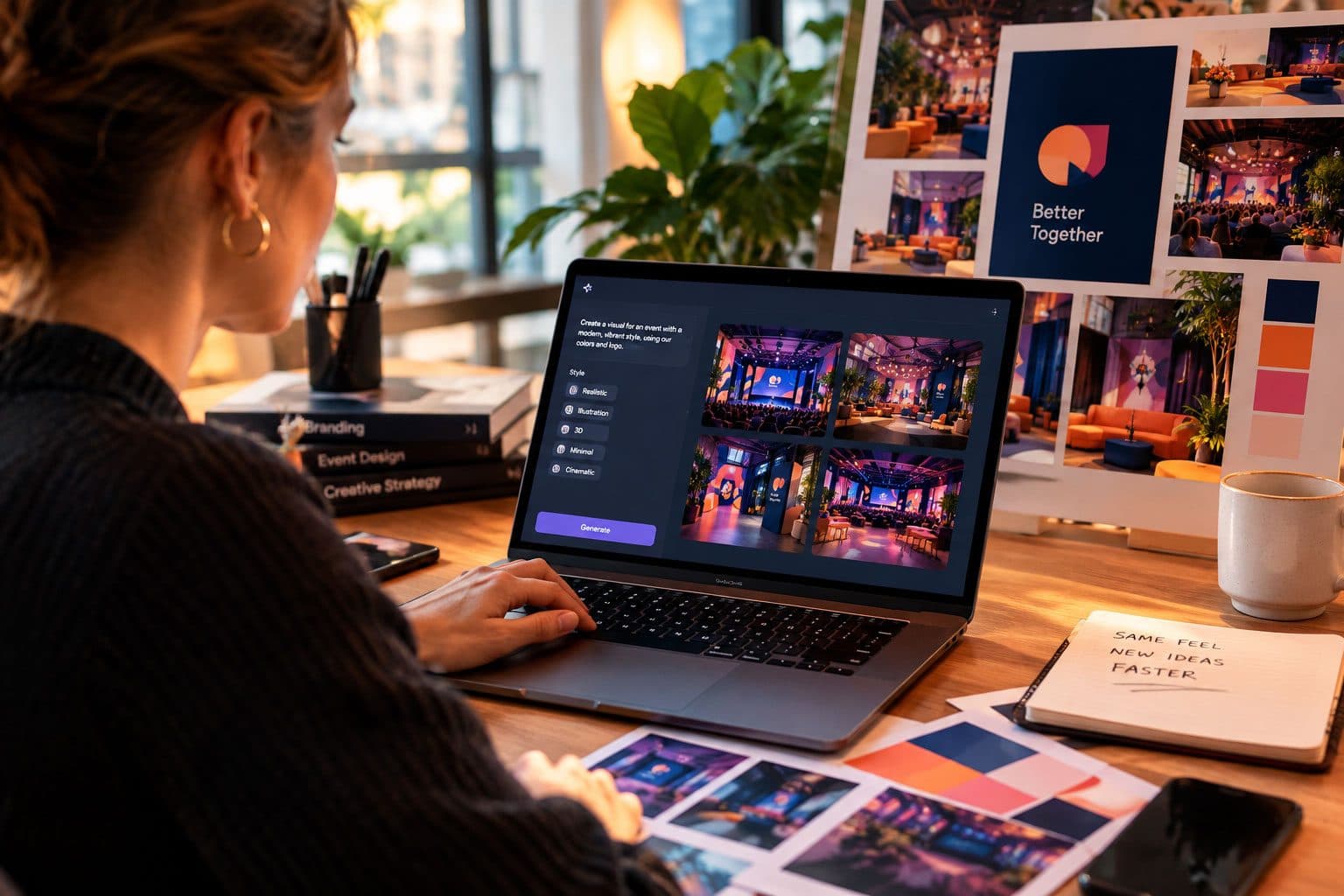
Does this mean you should ignore AI? Certainly not. The real power of smart tools lies not in the end result, but in the start-up phase of a project. Where it used to take days to develop various visual directions, mood boards or scenarios for an event concept, you can now visually map out dozens of directions within an afternoon.
See AI as a hyperactive intern: full of ideas, lightning-fast in execution, but without strategic insight. By using tools to explore metaphors, colour palettes or storyboard sketches, you significantly shorten the initial design phase. This leaves more budget and time for what really matters: refining the brand identity, thoughtful interactions on your website and perfecting the user experience.
Why emotion and brand identity always remain human work
An algorithm understands the data behind a target audience, but does not feel what drives that audience. It knows what an event poster looks like technically, but does not understand the tension a physical visitor experiences when the lights dim. It is precisely that human nuance that makes the difference between a functional design and an unforgettable brand experience.
A thoughtful concept arises from empathy, context and strategic choices. Why do we choose rough typography instead of clean lines? How does an interactive element on your website translate into a feeling of reliability? These are decisions rooted in human psychology and brand values. AI can provide building blocks, but the foundation and the architecture remain the domain of strategists and designers.
Three practical rules for your workflow
Do you want to successfully integrate AI into your own content or design process without diluting your brand values? Always start with tight frameworks. First feed the tools with your brand manual, your core values and specific style elements before asking for ideas. AI only works effectively when it is given clear boundaries.
Also, never publish unfiltered output. Use generated concepts exclusively as rough sketches that you then post-process, rewrite or redesign with artisanal precision. Ensure that the final imagery and tone of voice are unmistakably those of your organisation.
Finally: dare to deviate from what the software suggests. AI often proposes the most obvious route. Use those suggestions mainly to see what everyone else is already doing, so that you can consciously take the other turn. This way, technology remains an accelerator of creativity, rather than a replacement for originality.
Want to know more?
Curious what Custom Way Design can do for you in the field of flyer design?
View Flyer designGet in touch
Want to discuss an assignment or project? Tell us what you are working on — we reply within two working days.
Get in touch